 |  |  |  |
Straight Prohibited or No Entry | One Way Sign | One Way Sign | Vehicle Prohibited in Both Directions |
 |  |  |  |
| All Motor Vehicles Prohibited | Truck Prohibited | Bullock Cart Prohibited | Tonga Prohibited |
 |  |  |  |
| Hand Cart Prohibited | Cycle Prohibited | Pedestrians Prohibited | Right turn Prohibited |
 |  |  |  |
| Left Tturn Prohibited | U-Turn Prohibited | Overtaking Prohibited | Horn Prohibited |
 |  |  |  |
| Bullock Cart & Cart Prohibited | Length Limit | Speed Limit | Load Limit |
 |  |  |  |
| Height Limit | Width Limit | Axle Load Limit | Restriction Ends Sign |
 |  |  |  |
| No Parking | No Stopping or Standing | Compulsory Ahead Only | Compulsory Keep Left |
 |  |  |  |
| Compulsory Turn Left | Compulsory Tturn Right | Compulsory Turn Right Ahead | Compulsory Turn Left Ahead |
 |  |  |  |
| Compulsory Ahead or Turn Left | Compulsory Ahead or Turn Right | Compulsory Cycle Track | Compulsory Sound Horn |
 |  | ||
| Stop | Give Way | ||

Monday, 5 September 2011
Mandatory Signs or Regulatory Signs

Traffic Police Hand Signals
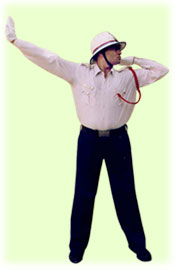 |  |
To start one sided vehicles | To stop vehicles coming from front |
 |  |
| To stop vehicles approaching from behind | To stop vehicles approaching simultaneously from front and behind |
 |  |
| To stop vehicles approaching simultaneously from right and left | To start vehicle approaching from left |
 |  |
| To start vehicles coming from right | To change sign |
 |  |
| To start one sided vehicles | To start vehicles on T-Point |
 |  |
| To give VIP salute | To manage vehicles on T-Point |
Hand Signals by Drivers
I intend to move in to the left or turn left | 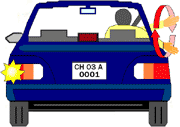 |
I intend to move out to the right or changing the lane or turn right |  |
I intend to stop | 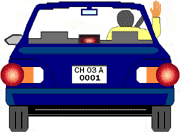 |
I intend to slow down | 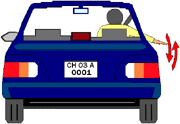 |
Indicating the car following you to overtake |  |
Road Regulations in India
Rules Of The Road Regulations was brought into effect from July 1, 1989. It serves as a basic guide for the Indian driver, showcasing the rules which he has to follow, while on the roads. It deals with basic facts such as overtaking, traffic signals, towing, speed limits, the necessary documents to be carried while driving and other such neglected, but imperative points nonetheless.
|

These regulations may be called the Rules Of The Roads Regulations, 1989. They shall come into force from July 1, 1989.
- Keep Left
The driver of a motor vehicle shall drive the vehicle as close to the left side of the road as may be expedient and shall allow all traffic which is proceeding in the opposite direction to pass on his left hand side.
- Turning to Left And Right
The driver of a motor vehicle shall:
- When turning to the left, drive as close as maybe to theleft hand side of the road from which he is making the turn and of the road which he is entering.
- When turning to the right draw as near as near as may be to the centre of the road which the driver is entering.
- When turning to the left, drive as close as maybe to theleft hand side of the road from which he is making the turn and of the road which he is entering.
- Passing To The Right
Except as provided in regulation 5, the driver of a motor vehicle shall pass to the right of all traffic proceeding in the same direction as himself.
- Passing To The Left
The driver of a motor vehicle may pass to the left of a vehicle, the driver of which having indicated an intention to turn to the right has drawn to the centre of the road and may pass on either side, a tram car or other vehicle running on fixed rails whether travelling in the same direction as himself or otherwise provided that in no case shall he pass a tram car at a time or in a manner likely to cause danger or inconvenience to other users of the road including persons leaving or about to enter tram cars.
- Overtaking Prohibited In Certain Cases
The driver of a motor vehicle shall not pass a vehicle travelling in the same direction as himself:
- If his passing is likely to pass inconvenience or danger to other traffic proceding in any direction
- If he is near a point, a bend or corner or a hill or other obstructionof any kind that renders the road ahead not clearly visible
- If he knows that the driver who is following him has not signalled that he may be overtaken.
- If his passing is likely to pass inconvenience or danger to other traffic proceding in any direction
- Overtaking Not To Be Obstructed
The driver of a motor vehicle shall not, when being overtaken or being passed by another vehicle, increse speed or do anything in any way to prevent the other vehicle from passing him.
- Caution At Road Junction
The driver of a motor vehicle shall slow down when approaching a road intersection, a road junction, pedestrian crossing or a road corner, and shall not enter any such intersection, junction or crossing until he has become aware that he may do so without endangering the safety of persons thereon.
- Giving Way To Traffic At Road Junction
The driver of a motor vehicle shall, on entering a road interjection at which traffic is not being regulated, if the road entered is a main road designated as such, give way to the vehicles proceeding along the road, and in any other case give way to all traffic approaching to the intersection on his right hand.
- Fire Service Vehicles And Ambulances To Be Given Free Passage
Each driver shall on the approach of a fire service vehicle or an ambulance allow it free passage by drawing it to the side of the road.
- Right Of Way
Pedestrians have the right of way at uncontrolled pedestrian crossings. When any road is provided with a footpath or cycletrack especially for other traffic, except with permission of a police officer in uniform, a driver shall not drive on such footpath or track. - Taking 'U' Turn
No driver shall take a 'U' turn where 'U' turn is especially prohibited and on a busy traffic road. If a 'U' turn is allowed the driver shall slow signal by hand as for a right turn, watch in the rear view mirror and turn when safe to do so.
- Signals To Be Given By Drivers
The following signals shall be used by drivers of all motor vehicles namely :
- When about to slow down, a driver shall extend his right arm with the palm downward and to the right of the vehicle and shall move the arm so extended up and down several times in such a manner that the signal can be seen by the driver of any vehiclewhich maybe behind him.
- When about to stop, the driver shall raise his right forearm vertically outside of and to the right of the vehicle, palm to the right.
- When about to turn to the right or to drive to the right hand sideof the road in order to pass another vehicle or for any other purpose, a driver shall extend his right hand in a horizontal position outside of and to the right of his vehicle with the palm of the hand turned to the front.
- When about to turn to the left or to drive to the left to the left hand side of the road a driver shall extend his right arm and rotate it in an anticlockwise direction.
- When a driver wishes to indicate to a driver of a vehicle behind him that he desires to overtake him he shall extend his right hand and arm horizontally outside of and to the right of the vehicle and shall bring the arm backward and forward in a semi- circular motion.
- When about to slow down, a driver shall extend his right arm with the palm downward and to the right of the vehicle and shall move the arm so extended up and down several times in such a manner that the signal can be seen by the driver of any vehiclewhich maybe behind him.
- Direction Indicator
The signals referred to in regulation (Taking "U" Turn), may be simplified also by mechanical or electrical devices.
- Parking Of The Vehicle
- Every driver of a motor vehicle parking on any road shall park in such a way that it does not causeor is not likely to cause danger, obstruction or undue in convenience to other roadusers and if the manner of parking is indicated by any sign board or markings on the road side, he shall park the vehicle in such a manner.
- A driver of a motor vehicle shall not park his vehicle
- At or near a road crossing, a bend, top of a hill or a humpbacked bridge
- On a footpath
- Near a traffic light or pedestrian crossing
- In a main road or one carrying fast vehicle
- Opposite another parked vehicle or as obstruction to other vehicle
- Alongside another parked vehicle
- On roads or at places where there is a continuous white line with or without a broken line
- Near a bus stop, school or hospital entrance or blocking a traffic sign or entrance to a premises or a fire hydrant
- On the wrong side of the road
- Where parking is prohibited
- Away from the edge of the footpath
- At or near a road crossing, a bend, top of a hill or a humpbacked bridge
- Every driver of a motor vehicle parking on any road shall park in such a way that it does not causeor is not likely to cause danger, obstruction or undue in convenience to other roadusers and if the manner of parking is indicated by any sign board or markings on the road side, he shall park the vehicle in such a manner.
- Visibility Of Lamps And Registeration Marks
- No load or other goods shall be placed on any motor vehicle so as to mark or otherwise interrupt vision of any lamp, registeration mark or any other mark required to be carried by or exhibited on any motor vehicle by or under the Act, unless a duplicate of the lamp so marked or otherwise obscured is exhibited in the manner required by or under the Act for the exhibition of the marked or obscured lamp or mark.
- All registeration and other marks required to be exhibited on a motor vehicle by or under the Act shall at all times be maintained in a clear and legible condition.
- No load or other goods shall be placed on any motor vehicle so as to mark or otherwise interrupt vision of any lamp, registeration mark or any other mark required to be carried by or exhibited on any motor vehicle by or under the Act, unless a duplicate of the lamp so marked or otherwise obscured is exhibited in the manner required by or under the Act for the exhibition of the marked or obscured lamp or mark.
- One Way Traffic
A driver shall not
- drive a motor vehicle on road declared 'One-Way' except in the direction specified by sign boards.
- drive a vehicle in a reverse direction into a road designated 'One Way'.
- drive a motor vehicle on road declared 'One-Way' except in the direction specified by sign boards.
- Driving On Channelised Roads ( Lane Traffic)
- Where any road is marked by lanes for movement of traffic, the driver of a motor vehicle shall drive within the lane and change the lane only after giving proper signal.
- Where any road is marked by a yellow line dividing road, vehicles proceeding in the same direction trying to ovrtake each other shall not cross the yellow line.
- Where any road is marked by lanes for movement of traffic, the driver of a motor vehicle shall drive within the lane and change the lane only after giving proper signal.
- Stop Sign On Road Surface
- When any line is painted on or inlaid into the surface of any road at the approach to the road junction or to a pedestrian crossing or otherwise, no driver shall drive a motor vehicle shall any part thereof projects beyond that line at any time when a signal to stop is being given by thr Police Officer or by means of traffic control light or by display of any traffic sign.
- A line for the purpose of this regulation shall not be less than 50 millimetres in width at any part and may be either in white, black or yellow.
- When any line is painted on or inlaid into the surface of any road at the approach to the road junction or to a pedestrian crossing or otherwise, no driver shall drive a motor vehicle shall any part thereof projects beyond that line at any time when a signal to stop is being given by thr Police Officer or by means of traffic control light or by display of any traffic sign.
- Towing
- No vehicle other than a mechanically disabled motor vehicle or incompletely assembled motor vehicle, a registered trailer or a side car, shall be drawn or towed by any motor vehicle, except for purposes of delivery and to the nearest filling station or garage.
- No motor vehicle shall be drawn or towed by any other motor vehicle unless there is in the driver's seat of the motor vehicle being drawn or towed a person holding a licence authorising him to drive the vehicle or unless the steering wheels of the motor vehicle being towed, are firmly and securely supported clear of the road surface by some crane or other device on the vehicle which is drawin or towing it.
- When a motor vehicle is being towed by another motor vehicle the clear distance between the rear of the front vehicle and the front of the rear vehicle shall at no time exceed five metres. The tow ropes, or chains shall be of a type-easily distinuishable by other road users and there shall be clearly displayed on the rear of the vehicle being towed in black letters not less than seventy - five mllimetres high and on a white background the words 'ON TOW'.
- No motor vehicle when towing another vehicle other than a trailer or a sidecar shall be driven at a speed exceeding twenty- four kilometres per hour.
- No vehicle other than a mechanically disabled motor vehicle or incompletely assembled motor vehicle, a registered trailer or a side car, shall be drawn or towed by any motor vehicle, except for purposes of delivery and to the nearest filling station or garage.
- Use Of Horns And Silence Zones
A driver of a vehicle shall not :
- Sound the horn needlessly or continuously or more than necessary to to ensure safety.
- Sound the hirn in silence zones.
- Make-use of a cut-out by which gases are released other than through the silencer.
- Fit or use any multitoned horn giving a harsh, shrill, loud or alarming noise.
- Drive a vehicle creating undue noise when in motion.
- Drive a vehicle with a muffler causing alarming sound.
|
- Traffic Signs And Traffic Police
A driver of a motor vehicle and every other person using the road shall obey :
- Every direction given, whether by signal or otherwise, by a police officer or any authorised person for the time being incharge of the regulations of traffic.
- Any direction applicable to him and indicated on or by notice, traffic sign or signal fixed or operated by an authority, competent to do so.
- Any direction indicated by automatic signalling devices fixed at road intersections.
- Every direction given, whether by signal or otherwise, by a police officer or any authorised person for the time being incharge of the regulations of traffic.
- Distance From Vehicles In Front
The driver of a motor vehicle moving behind another vehicle shall keep at a sufficient distance from that other vehicle to avoid collision if the vehicle in front should suddenly slow down or stop.
- Abrupt Brake
No driver of a vehicle shall apply brake abruptly unless it is necessary to do so for safety reasons.
- Vehicles Going Uphill To Be Given Precedence
On mountain roads and steep roads, the driver of a motor vehicle travelling down the hill shall give precedence to a vehicle going uphill wherever the road is not sufficiently wide to allow the vehicles to pass each other freely without danger, and stop the stop the vehicle to the side of the road in order to allow any vehicle proceeding uphill to pass.
- Obstruction Of Driver
A driver of a motor vehicle shall not allow any person to stand or sit or anything to be placed in such a manner or position as to hamper his control of the vehicle.
- Speed TO Be Restricted
The driver of a motor vehicle shall, when passing a meeting or procession or a body of troops or police on the march or when passing workmen engaged on road repair, drive at a speed not exceeding 25 kilometres an hour.
- Driving Of Tractors And Goods Vehicles
A driver when driving a tractor shall not carry or allow any personto be carried on the tractor. A driver of a goods carriage shall not carry in the the driver's cabin more numbers of persons than that mentioned in the registeration certificate and shall not carry passengers for hire or reward.
- Projection Of Loads
No person shall drive in any public place any motor vehicle which is loaded in a manner likely to cause danger to any person in such a manner that the load or any part thereof or anything extends literally beyond the side of the body or to the front or to rear or in height beyond the permissible limit.
- Restriction To Carriage
Except for the fuel and the lubricants necessary for the use of the vehicle, no explosive. highly flammable or otherwise dangerous substance shall be otherwise carried on any public service vehicle.
- Restrictions ON Driving Backwards
No driver of a motor vehicle shall cause the vehicle to be driven backwards without first satisfying himself that he will not thereby cause danger or undue inconvenience to any other person or in any circumstances, for any greater distance or period of time than maybe reasonably necessary in order to turn the vehicle round.
- Production Of Document
A person driving a vehicle:
- Shall always carry with him his driving licence; certificate of registeration; certificate of taxation and certificate of insurance of the vehicle and in case of transport vehicle the permit and witness certificate also
- Shall on demand by ppolice officer in uniform or an officer of the Motor Vehicle Department in uniform or any other officer authorised by the Government, produce the documents for inspection.
- Shall always carry with him his driving licence; certificate of registeration; certificate of taxation and certificate of insurance of the vehicle and in case of transport vehicle the permit and witness certificate also
- Every driver must
be conversant with the provisions of Sections 112, 113, 121, 122, 125, 132, 134, 185, 186, 194, 207 of the Motor Vehicle Act, 1988.
Indian Traffic Rules and Regulations
Traffic Rules and Regulations
Sections
Every driver should possess adequate knowledge and understanding of the following provisions of Motor Vehicle Act 1988 :
Section 122)Leaving vehicle in dangerous position
No person shall park his vehicle in public place in such a way that it causes danger,obstruction or inconvenience to other road users.
Section 123)Riding on running board
Carriage of persons on running board and on the top or on the bonnet of motor vehicle is strictly prohibited.
Section 125)Obstruction to the driver
No person driving a motor vehicle shall allow any person to stand or sit or anything to be placed in such a manner as to hamper the driver in his control of the vehicle.
Section 126)Stationary vehicle
While keeping the vehicle stationery in public place its Mechanism should be stopped, brakes must be applied or such measures should be taken as to ensure that vehicle cannot accidently be put in motion.
Section 128)Pillion Rider
No driver of two-wheeled motor cycle shall carry more than one person, on pillion seat.
Section 130)Production of Documents
A) The driver of motor vehicle in any public place shall on demand produce his driving licence and certificate of registration of the vehicle for examination.
B) Beside these documents driver of transport vehicle shall produce Road Permit Fitness Certificate, Authorisation if any Certification of Taxation on demand.
Section 134) Duty of Driver in case of Accident
If you are involved in an accident then you should -
Whoever, while driving, or attempting to drive, a motor vehicle shall be punishable for the first offence with imprisonment for a term which may extend to six month, or with fine which may extend to Rs.2000/- or with both.
Section 186)Driving when mentally or physically unfit to drive
Whoever drives a motor vehicle in any public place when he is to his knowledge suffering from any disease or disability, calculated to cause his driving of the vehicle to be a source of danger to the public, shall be punishable for the first offence with fine which may extend to Rs.200/-.
Section 207)Power to detain the vehicle
The Motor Vehicle Inspector may detain the vehicle used -
The driver of a motor vehicle shall slow down when approaching a road intersection, a road junction, pedestrian crossing or a road corner, and shall not enter, until he has become aware that the he may do so without endangering the safety of persons thereon and shall give way to all traffic approaching on the right hand side of the road. On mountains road or steep roads vehicles traveling down hill shall give precedence to vehicle going up hill.
Fire service vehicles and ambulance to be given free passage
Every driver shall on the approach of fire service vehicle or of an ambulance allow it free passage by drawing his vehicle to the left side of the road.
Pedestrial crossing
The pedestrian have right of way at any pedestrian crossings (Zebra crossing). When a solid yellow or white line is painted on road at pedestrian crossing no driver shall drive a motor vehicle so that part thereof projects beyond that line.
Towing
The driver of vehicle moving behind another shall keep sufficient distance from the vehicle in front (one vehicle length distance for every 15km/hr). More the speed more is the distance between two vehicles.
Carrying persons in tractor and goods vehicles
A driver when driving a tractor shall not carry or allow to carry any person on tractor. Goods vehicles driver shall not carry passengers on Hire or Reward.
Number of persons / labour allowed to carry in the vehicle
A) Three Wheeler (but not by the side of driver) - 1 Bonafide employee
1) LMV Transport (D/van,Tempo) - 3 Bonafide employee
2) Heavy goods vehicle (Truck) - 6 Bonafide employee
(Not applicable for vehicle plying on inter state route or from one city to another city)
Projection of load :-
No Person shall drive any motor vehicle with is loaded in manner likely to cause danger to any person in such manner that the load projects laterally beyond the side of body or to the front or the rear or in height beyond permissible limits. (Projection in Height - 3.8mtrs. Projection at the Rear -1.85mtrs.)
Driving reverse gear :-
No driver shall drive in reverse gear without first satisfying himself that it will not cause danger to others.
Use of horns and silence zones :-
A driver of a vehicle shall not -
Sections
Every driver should possess adequate knowledge and understanding of the following provisions of Motor Vehicle Act 1988 :
Section 122)Leaving vehicle in dangerous position
No person shall park his vehicle in public place in such a way that it causes danger,obstruction or inconvenience to other road users.
Section 123)Riding on running board
Carriage of persons on running board and on the top or on the bonnet of motor vehicle is strictly prohibited.
Section 125)Obstruction to the driver
No person driving a motor vehicle shall allow any person to stand or sit or anything to be placed in such a manner as to hamper the driver in his control of the vehicle.
Section 126)Stationary vehicle
While keeping the vehicle stationery in public place its Mechanism should be stopped, brakes must be applied or such measures should be taken as to ensure that vehicle cannot accidently be put in motion.
Section 128)Pillion Rider
No driver of two-wheeled motor cycle shall carry more than one person, on pillion seat.
Section 130)Production of Documents
A) The driver of motor vehicle in any public place shall on demand produce his driving licence and certificate of registration of the vehicle for examination.
B) Beside these documents driver of transport vehicle shall produce Road Permit Fitness Certificate, Authorisation if any Certification of Taxation on demand.
Section 134) Duty of Driver in case of Accident
If you are involved in an accident then you should -
- Stop
- Give your own and vehicle owners name and address to any person who gives his name and address
- Give possible medical aid to injured person.
- Report the matter to the nearest Police Station as soon as possible or within 24 hours.
Whoever, while driving, or attempting to drive, a motor vehicle shall be punishable for the first offence with imprisonment for a term which may extend to six month, or with fine which may extend to Rs.2000/- or with both.
Section 186)Driving when mentally or physically unfit to drive
Whoever drives a motor vehicle in any public place when he is to his knowledge suffering from any disease or disability, calculated to cause his driving of the vehicle to be a source of danger to the public, shall be punishable for the first offence with fine which may extend to Rs.200/-.
Section 207)Power to detain the vehicle
The Motor Vehicle Inspector may detain the vehicle used -
- Without certificate of registration.
- Without permit.
- Without driving licence
- Overtaking is prohibited at blind turns, corners, hill top, when indicated not to overtake by traffic signal or road markings.
- Overtaking only from right hand side. (Except when vehicle ahead is turning right)
- Make your intentions clear before overtaking & do not overtake unless driver ahead permits you to do so.
- While overtaking, distance of vehicle coming from opposite direction, its speed and road gradient plays an important role.
- Before starting to overtake look in your rear view mirror & confirm that nobody else is overtaking you.
- If in doubt do not overtake.
- When being overtaken driver shall not increase speed or do anything to other vehicle passing it.
- Come back to your own lane as soon as the vehicle which you have overtaken is seen in the mirror.
The driver of a motor vehicle shall slow down when approaching a road intersection, a road junction, pedestrian crossing or a road corner, and shall not enter, until he has become aware that the he may do so without endangering the safety of persons thereon and shall give way to all traffic approaching on the right hand side of the road. On mountains road or steep roads vehicles traveling down hill shall give precedence to vehicle going up hill.
Fire service vehicles and ambulance to be given free passage
Every driver shall on the approach of fire service vehicle or of an ambulance allow it free passage by drawing his vehicle to the left side of the road.
Pedestrial crossing
The pedestrian have right of way at any pedestrian crossings (Zebra crossing). When a solid yellow or white line is painted on road at pedestrian crossing no driver shall drive a motor vehicle so that part thereof projects beyond that line.
Towing
- No vehicle other than mechanically disabled vehicle shall be towed by any vehicle.
- There shall be a licence holder driver in the vehicle being towed or its steering wheels shall be elevated from the road.
- On the rear of vehicle being towed letters "ON TOW" shall be displayed.
- Distance between two vehicle shall not be more than 5mts.
- Speed of the vehicle towing another vehicle shall not be more than 24 km/Hrs.
The driver of vehicle moving behind another shall keep sufficient distance from the vehicle in front (one vehicle length distance for every 15km/hr). More the speed more is the distance between two vehicles.
Carrying persons in tractor and goods vehicles
A driver when driving a tractor shall not carry or allow to carry any person on tractor. Goods vehicles driver shall not carry passengers on Hire or Reward.
Number of persons / labour allowed to carry in the vehicle
A) Three Wheeler (but not by the side of driver) - 1 Bonafide employee
1) LMV Transport (D/van,Tempo) - 3 Bonafide employee
2) Heavy goods vehicle (Truck) - 6 Bonafide employee
(Not applicable for vehicle plying on inter state route or from one city to another city)
Projection of load :-
No Person shall drive any motor vehicle with is loaded in manner likely to cause danger to any person in such manner that the load projects laterally beyond the side of body or to the front or the rear or in height beyond permissible limits. (Projection in Height - 3.8mtrs. Projection at the Rear -1.85mtrs.)
Driving reverse gear :-
No driver shall drive in reverse gear without first satisfying himself that it will not cause danger to others.
Use of horns and silence zones :-
A driver of a vehicle shall not -
- Sound the horn needlessly or continuously or more than necessary to ensure safety.
- Sound the horn in silence zones.
- Drive a vehicle creating undue noise when in motion.
- Drive a vehicle with a muffler causing alarming sound.
- Sound the multi tuned horn or shrill horns.
Monday, 22 August 2011
In front of one of the most popular politicians' house
Date: 22 Aug 2011 at 1:10PM
Location: You can easily recognize the place in video, Visakhapatnam.
Incident:
As it is clearly visible from the above video, some vehicles are parked by occupying 50% of the road and it is happened in front of a most popular politician's house.
Our Observation:
Vehicles are parked in front of a politician's house and those are his visitors' vehicles. This is not the first time and not occasional activity. This happens regularly at that place and people struggles a lot to travel in that road.
Suggestions to Traffic Department:
NO COMMENTS.......
Suggestions to Public:
........
JAGO INDIA JAGO............
Milk Vending on Akkayyapalem Main Road
Date: 21 Aug 2011 at 6:30PM
Location: Akkayyapalem Road, Visakhapatnam.
Incident:
As it is clearly visible from the above video, the milk vendor kept the milk trays on the road by occupying 30% of the road. And we can also observe an Ambassador car parked for a while on the road.
Our Observation:
People thinking that the road is their own property and using it for their personal needs. A milk vendor placed his milk trays on the road, An Ambassador car has been parked in the middle of the road for a a while and a reckless guy walking casually in the middle of the road as if he is walking in his corridor.
Suggestions to Traffic Department:
The traffic department should realize that defining rules is not enough. All the rules should be implemented with no mercy & obligations.Suggestions to Public:
Respecting Traffic Rules is our minimum responsibility. Please remember that all the rules are defined by us for our convenience.
JAGO INDIA JAGO............
Subscribe to:
Posts (Atom)